
Storm and Hail Damage Repair
Storm damage roof repair in Huntsville starts with a tarp, usually $300 to $800, and ends with either a repair in the $400 to $2,500 range or an insurance-backed replacement when hail or wind has done enough. North Alabama's severe weather season runs March through May with a second window in November, and we tarp, document and repair storm-damaged roofs across Madison County through both.
The 2011 outbreak is still the storm people here measure everything against, but most storm roof work is smaller: a front comes through at 60 miles an hour, a limb goes through the decking in Blossomwood, a dozen shingle tabs peel off a Madison roof, or a hail core drops 1.5 inch stones across Harvest for four minutes.
What you do in the first day decides how expensive the rest of it is.
Storm season here
Madison County sits on the eastern edge of Dixie Alley. Spring fronts come out of the southwest, and the open farmland on the northwest side of the county around Harvest, Toney and Hazel Green takes the first and hardest hit. Inside Huntsville the ridge lots on Monte Sano, Green Mountain and above Jones Valley get stronger gusts than the valley floor.
Hail follows the same geography. Most Madison County hail is an inch or under and mostly bruises shingles without opening them. The 1.5 to 2 inch events that come through every few years are the ones that crack mats, strip granules to the fiberglass and total roofs, and insurers know the dates of those storms as well as roofers do.
November brings a second, shorter season. Ice is rare but when it comes it finds weak flashing and freezes under lifted shingles.
First 24 hours
Get the water stopped inside first. A bucket and a small hole poked in a sagging ceiling bubble will save the drywall around it.
Photograph everything before anything is moved: the ceiling, the yard debris, the shingles on the ground, the gutter dents. Date-stamped phone photos are fine. Do not climb the roof.
Send us the form with those photos and the address. In the days after a county-wide storm we triage by severity: open decking and active leaks get tarped first, missing shingles second, hail inspections after that.
Do not sign anything with a door-knocker. After every major Madison County storm, crews from out of state work the subdivisions with contingency agreements. Some are fine. Some leave with the deductible and a half-finished roof. A local company with a local address will still be here next spring.
Emergency tarping
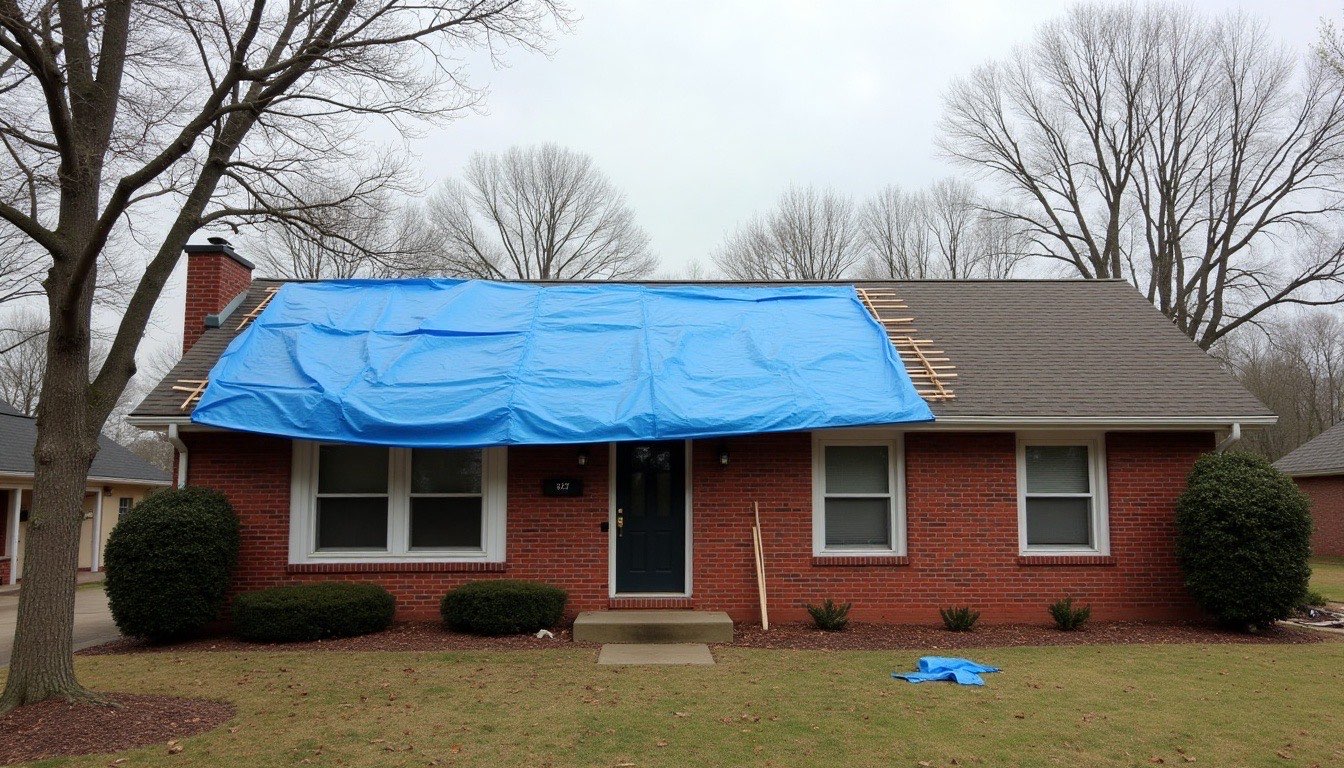
A tarp is a temporary roof, and done right it holds for weeks. We use a heavy tarp run over the ridge so water cannot get under the top edge, fastened with furring strips rather than a handful of nails through the sheet, and weighted at the eave. On a steep or two-story roof it is a two-person job for safety.
Typical tarping cost is $300 to $800 depending on size and pitch, and it goes on the insurance file as mitigation, which most policies cover separately from the repair itself.
For a tree through the roof we cut back the limbs that are on the roof, tarp over the decking hole with a plywood patch underneath when the opening is large, and photograph the interior framing for the adjuster. Tree removal from the yard is a separate trade.
What hail and wind do to shingles
Wind lifts the shingle tabs on the windward slopes, breaks the seal strip, and on older roofs creases or tears the tab. A creased shingle is a failed shingle even if it lays back down. Look for tabs on the ground, lifted edges along the north and west slopes, and ridge cap pieces in the gutter.
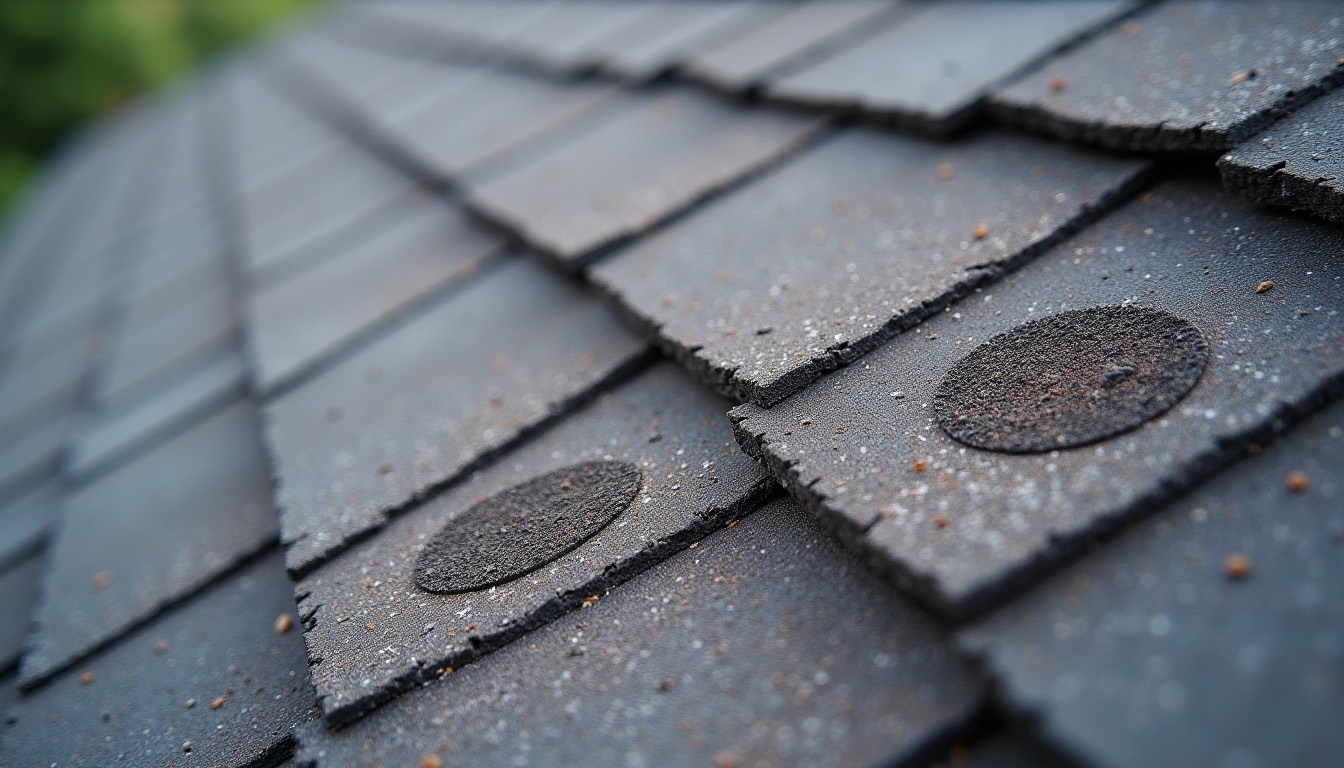
Hail bruises. On an architectural shingle a 1 inch stone knocks granules loose in a round spot and leaves the mat soft underneath, like a bruise on fruit. Larger stones crack the mat. From the ground hail damage is nearly invisible; up close it shows as dark circles with a soft center, and it shows on the metal too, in dented gutters, downspouts, vent caps and the soft aluminum of a window screen frame.
Adjusters count hits in a 10 foot by 10 foot test square on each slope. Roughly 8 or more hits per square on multiple slopes usually supports a replacement; a few hits on one slope usually supports a repair.
Documentation your adjuster wants
Every storm job we touch gets the same file: wide shots of each slope, close-ups of every hit or lifted tab with a chalk circle and a measuring reference, photos of collateral damage on gutters and vents, the attic from below where water came through, and the interior ceiling. Each photo is dated and labeled by slope.
With that file in hand, the claim conversation is about the scope of repair rather than whether damage exists. We meet the adjuster on the roof when you want us to and walk the slopes together.
If the damage does not justify a claim we will say so. A $900 wind repair paid out of pocket is better than a claim on your record for a payout under your deductible, and most Madison County policies now carry a 1 to 2 percent wind and hail deductible, which is $4,000 to $8,000 on a $400,000 house.
Repair scope and timeline
Wind repairs on a few squares are usually $400 to $2,500 and done in a single visit once the weather clears. We reset or replace the damaged shingles, re-nail and re-seal the surrounding courses, and replace any ridge cap that lifted.
Hail repairs on one slope run similar money. A full replacement after a confirmed hail total follows the same process as any re-roof: tear-off, decking check, underlayment, new flashing, new shingles, usually in one day for a typical house. The roof replacement page walks through it.
Timeline after a county-wide storm: tarps inside 24 to 72 hours, inspections and documentation over the following one to two weeks, repairs and replacements scheduled as claims clear. Outside storm weeks, most repairs are on the roof within a few days.
Questions we get
How long after a storm can I file a roof claim in Alabama?
Most Alabama homeowner policies give you one to two years from the date of loss, but the practical window is shorter: the longer the gap, the harder it is to tie damage to a specific storm. Get a documented inspection within a few weeks of a hail or wind event, even if nothing is leaking yet.
Will my insurance go up if I file a hail claim?
Weather claims are generally treated as no-fault, but a claim history still affects renewals and the premium with some carriers. That is why we tell you when damage is under the deductible or marginal, so you can decide whether a claim is worth filing.
Should I let a roofer knock on my door after a storm?
You can listen, but do not sign a contingency agreement on the spot. Ask for a local address, photos of your actual roof, and a written scope. Get a second inspection from a company that was here before the storm and will be here after.
Can a roof be repaired after hail, or does it have to be replaced?
Both happen. A few hits on one slope is a repair. Eight or more hits per test square across multiple slopes, or cracked mats, usually means replacement, and at that point the insurer is typically paying for it minus your deductible. The photo count decides it, not the salesman.
Send storm photos now
Attach what you can see from the ground and from inside, add the address, and send the form. Open roofs and active leaks go to the front of the line. Harvest and Toney are on the same list as Huntsville after a storm; we work the county by severity, not by zip code.