Metal Roofing
A standing seam metal roof installed in Huntsville runs roughly $900 to $1,600 per square in 2026, which is two to three times the cost of architectural shingles, and it should outlast two of them. Exposed-fastener panels run $600 to $1,000 per square installed. We install both, and we repair the metal roofs already on homes across Madison County, most often by replacing backed-out screws and resealing seams and penetrations.
Metal is a bigger share of what we do every year. It started with rural homes in New Market and Hazel Green and farmhouse-style new builds, and it is now showing up on 1960s ranches in south Huntsville where the owner wants the last roof they ever buy.
Below is what works here, what it costs against shingles, and when metal over shingle is a good idea versus a shortcut.
Why metal works in the Tennessee Valley
Three things wear out a Huntsville roof: heat, wind and hail. Metal handles two of them outright. A light-colored or reflective metal roof runs 20 to 40 degrees cooler on the surface than dark asphalt in a 95 degree August, which lowers attic temperature and the cooling bill with it. Standing seam panels mechanically fastened at the seams carry wind ratings well beyond what shingles are tested to, which matters on the Monte Sano and Green Mountain ridges and on the open ground around Harvest.
Hail is the one honest tradeoff. Metal does not leak from a 1 inch hail hit, but a heavy-gauge panel can show cosmetic dents from 1.5 to 2 inch stones. Most policies cover functional damage and exclude cosmetic damage on metal, so read the policy before choosing a thin-gauge panel on a budget.
Metal also sheds the 54 inches of rain we get here faster than any shingle and does not grow the algae streaks that darken north-facing shingle slopes within a few years.
The noise question comes up on every quote. On a house with solid decking, underlayment and attic insulation, rain on a metal roof is no louder inside than rain on shingles. The tin-roof drumming people remember is from an uninsulated barn or a porch with open rafters. We will say the same thing about ice: metal sheds it in sheets, so on a roof with a door or a walkway below the eave we add snow guards above it.
Standing seam vs exposed fastener
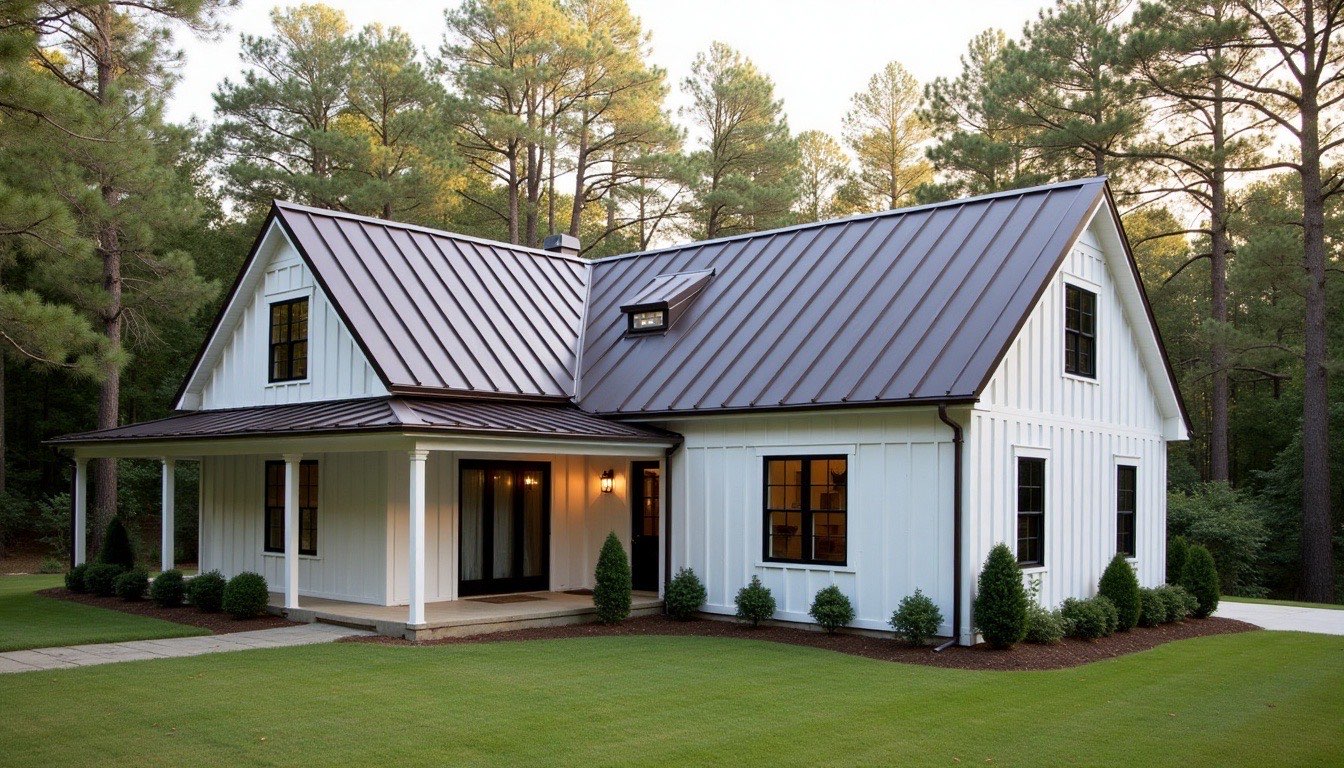
Standing seam uses wide panels with raised seams and hidden clips. No screws through the face of the panel, so nothing to back out and nothing to reseal every 10 years. It is the right choice on a house you plan to keep, and it is what you see on the newer builds in Hampton Cove and the custom homes off Winchester Road.
Exposed-fastener panels, sometimes called R-panel or ag panel, are screwed through the face with gasketed screws. They cost about a third less installed and go on faster. The tradeoff is maintenance: the gaskets harden in the heat and the screws loosen as the panel expands and contracts, so the roof wants a screw check and reseal roughly every 8 to 12 years. On barns, shops and rural homes they are a sensible choice.
Gauge matters as much as profile. We quote 26 gauge as the standard for homes and 24 gauge where hail or long panel runs justify it. 29 gauge is barn material and shows every dent.
Metal over shingle and permits
Installing metal directly over one layer of existing shingles is allowed in most of our area and it saves the tear-off and dump cost, usually $1,500 to $3,000 on a typical house. We do it when the existing shingles are flat and the decking is sound, with a synthetic underlayment or purlins between the layers so the shingle granules do not abrade the panel back.
We do not do it over two layers, over curled or buckled shingles, or on a roof with known soft decking, because the metal hides every one of those problems until it is expensive. If the attic shows water stains or the roof walks soft, the shingles come off first and the decking gets fixed.
We pull a permit where the city or county requires one and put the fee on the estimate.
What it costs vs shingles
Take a 2,000 square foot single-story ranch at about 25 squares. Architectural shingles with full tear-off in Huntsville run $10,000 to $14,000. Exposed-fastener metal on the same roof runs $15,000 to $25,000. Standing seam runs $22,000 to $40,000 depending on gauge, panel width and how many hips and valleys need custom trim.
Over 50 years the math usually flips. The shingle roof gets replaced twice and the metal roof gets a screw check or nothing. Add a possible insurance discount for a Class 4 rated metal roof and a lower cooling bill and the gap narrows further. Whether that trade is right depends on how long you plan to own the house, which is a question for you and not for us.
The written quote lists the panel, gauge, finish, underlayment, trim and fasteners as separate lines so you can compare it to any other metal bid on the same terms.
Repairing an existing metal roof
Most metal roof leaks in Madison County are on exposed-fastener roofs that are 10 to 20 years old. The fix is a screw replacement with larger-diameter gasketed screws, a reseal at pipe boots and the ridge, and new butyl at any panel laps that have opened. A full screw-and-seal on an average house runs $800 to $2,000 and resets the clock for another decade.
Standing seam roofs rarely leak in the field. When they do it is at a penetration, a wall transition, or where a satellite installer drove a lag through the panel. Those are small repairs, typically $300 to $900.
We also replace storm-damaged individual panels and re-seat panels that lifted in wind. Panel color matching on older roofs is imperfect because finishes fade, so we tell you that up front and place the replacement panel where it reads best.
Price a metal roof without a sales pitch
Send the form with the address, the roof's age, and whether you are leaning standing seam or exposed fastener. We measure and send a per-square written quote with panel and gauge options. New Market and Hazel Green are regular stops for us, so rural addresses are no problem.